
- Understanding Pharma Business Models
- What Is a PCD Pharma Franchise?
- What Is Third Party Manufacturing?
- Key Differences Between PCD Pharma Franchise and Third Party Manufacturing
- Advantages of PCD Pharma Franchise
- Advantages of Third Party Manufacturing
- Which Model Is Better for Your Pharma Business?
- Final Thoughts
India’s pharmaceutical industry offers strong business opportunities for entrepreneurs, distributors, and healthcare professionals. However, before entering this sector, one of the most important decisions is choosing the right business model.
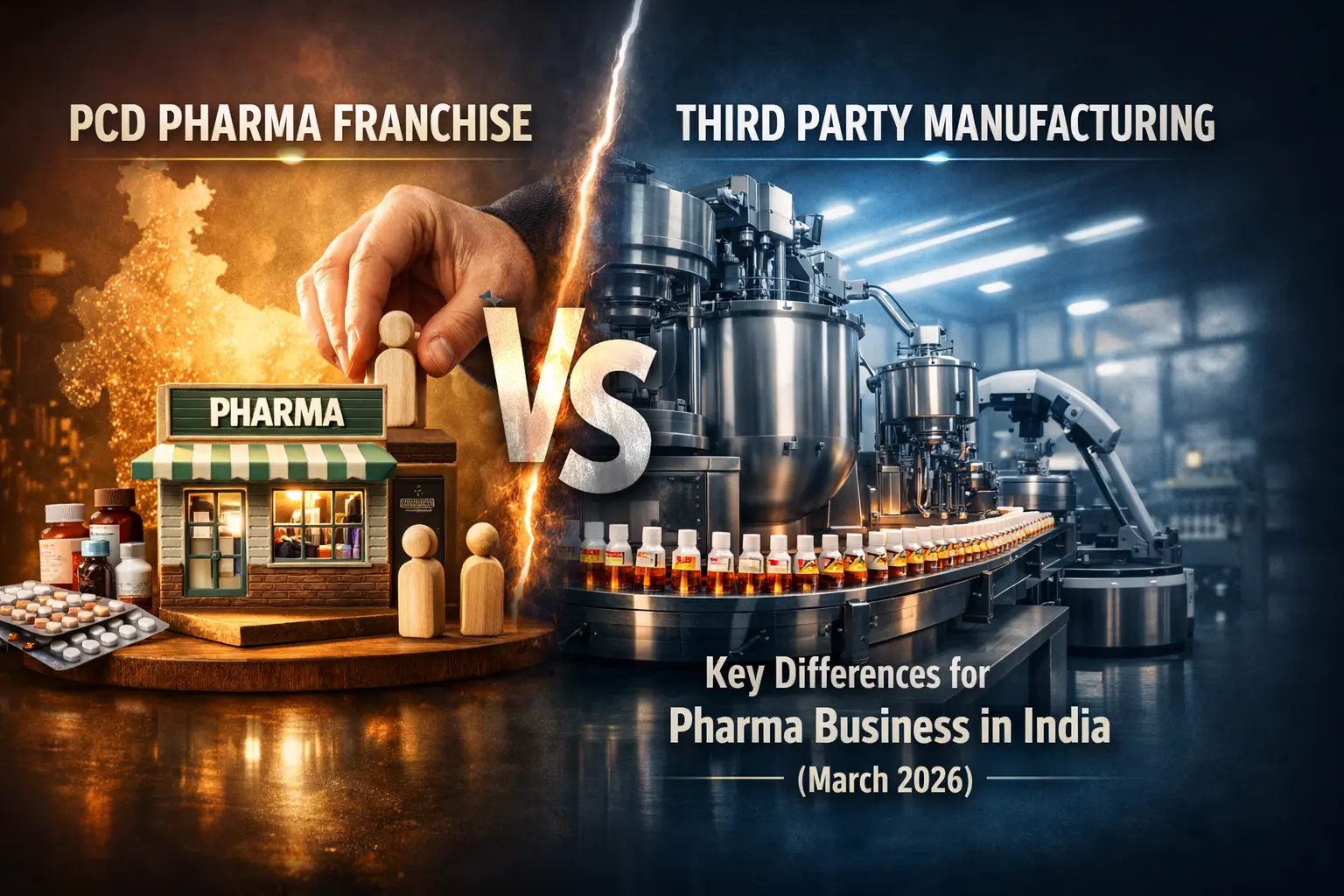
PCD Pharma Franchise allows individuals or distributors to market and sell a company’s medicines under its brand with monopoly rights in a region. Third-Party Manufacturing means a pharma company outsources production to another manufacturer while selling products under its own brand. One focuses on distribution; the other focuses on production outsourcing.
If you are planning to enter the pharmaceutical market, understanding the difference between these two models can help you choose the right path for your business.
Understanding Pharma Business Models
The pharmaceutical industry works through several distribution and production systems. Many companies manufacture medicines but rely on partners to distribute and promote them in different regions.
Similarly, some companies want to sell medicines under their own brand but prefer outsourcing the manufacturing process to specialized facilities.
This is where PCD pharma franchise and third party manufacturing models come into play. Both models reduce the need for large infrastructure investments and allow businesses to participate in the pharma sector more easily.
What Is a PCD Pharma Franchise?
A PCD (Propaganda Cum Distribution) Pharma Franchise is a business model where a pharmaceutical company gives distribution and marketing rights to an individual or distributor for a particular region.
In this model, the parent pharma company manufactures medicines and provides its product portfolio to franchise partners. The franchise partner then promotes and sells these products to doctors, pharmacies, and healthcare institutions in their assigned area.
Key Features of PCD Pharma Franchise
• Low initial investment
• Monopoly rights for a specific territory
• Ready product portfolio
• Marketing and promotional support
• No need to manage manufacturing
The franchise partner mainly focuses on sales, promotion, and distribution, while the pharmaceutical company handles production, quality control, and regulatory approvals.
This model is often preferred by new entrepreneurs or medical representatives who want to start a pharma business with limited risk.
What Is Third Party Manufacturing?
Third party manufacturing (also called contract manufacturing) is a business arrangement where a company outsources the production of its pharmaceutical products to another manufacturer.
In this case, the business owns the brand name and product identity but relies on an established manufacturing company to produce the medicines.
For example, if a company wants to launch its own branded tablets, capsules, or syrups but does not have a manufacturing facility, it can partner with a third-party manufacturer to produce the medicines under its brand.
Key Features of Third Party Manufacturing
• Ownership of your own brand
• Customized product formulations
• Scalable production capacity
• No need to invest in a manufacturing plant
• Full control over marketing and branding
This model is typically chosen by growing pharmaceutical companies or distributors who want to build their own brand identity in the market.
Key Differences Between PCD Pharma Franchise and Third Party Manufacturing
Although both models are part of the pharmaceutical supply chain, they operate differently in terms of investment, brand ownership, and operational responsibilities.
| Factor | PCD Pharma Franchise | Third Party Manufacturing |
|---|---|---|
| Investment | Low | Medium to High |
| Brand Ownership | Parent company brand | Your own brand |
| Manufacturing Responsibility | Parent company | Outsourced manufacturer |
| Marketing Responsibility | Franchise partner | Brand owner |
| Risk Level | Low | Moderate |
| Product Control | Limited | Full control |
| Scalability | Moderate | High |
| Best For | New entrepreneurs | Growing pharma businesses |
This comparison clearly shows that each model serves different business objectives.
Advantages of PCD Pharma Franchise
The PCD pharma franchise model is considered one of the easiest ways to enter the pharmaceutical industry.
1. Low Investment Requirement
Starting a PCD franchise usually requires a smaller investment compared to other pharma business models. Entrepreneurs can start with a manageable budget.
2. Established Brand Support
Franchise partners benefit from an existing brand reputation, product portfolio, and marketing materials provided by the parent company.
3. Monopoly Rights
Many pharma companies provide exclusive territorial rights, allowing franchise partners to operate in a specific area without direct competition from the same brand.
4. Reduced Operational Complexity
Since manufacturing, quality control, and regulatory approvals are handled by the pharma company, franchise partners can focus on sales and distribution.
Advantages of Third Party Manufacturing
Third party manufacturing is often preferred by businesses that want to develop their own brand in the pharmaceutical market.
1. Brand Ownership
The biggest advantage of this model is that you own the brand name. This allows companies to build long-term brand recognition in the market.
2. Product Customization
Businesses can develop their own formulations, packaging designs, and product strategies based on market demand.
3. Scalable Production
With third party manufacturing, production volumes can be increased easily as the business grows.
4. Higher Profit Potential
Since the company owns the brand, it has more flexibility in pricing, marketing strategies, and profit margins.
Which Model Is Better for Your Pharma Business?
Choosing between PCD pharma franchise and third party manufacturing depends mainly on your investment capacity, business goals, and level of experience in the pharma industry.
Choose PCD Pharma Franchise If:
• You are new to the pharmaceutical business
• You want a low-risk startup model
• You prefer selling established products
• You have limited investment capital
This model allows entrepreneurs to enter the market quickly while gaining experience in pharmaceutical distribution and sales.
Choose Third Party Manufacturing If:
• You want to build your own pharmaceutical brand
• You have a larger investment budget
• You want full control over product strategy
• You are planning long-term expansion
This model is more suitable for businesses that want to establish their brand identity and scale their product portfolio over time.
Final Thoughts
Both PCD Pharma Franchise and Third Party Manufacturing offer excellent opportunities in India’s rapidly growing pharmaceutical sector. The right choice depends on your business vision and resources.
A PCD pharma franchise is often the best option for beginners who want to enter the market with minimal investment and lower operational risk. On the other hand, third party manufacturing is ideal for businesses aiming to build their own brand and expand their product range.
Before starting your pharma business, it is important to evaluate your investment capacity, long-term goals, and market strategy. Partnering with a reliable pharmaceutical company can also make a significant difference in building a successful and sustainable pharma venture.
With the right approach and a clear understanding of these two models, entrepreneurs can take advantage of the growing demand in the pharmaceutical industry and build a profitable business in this sector.